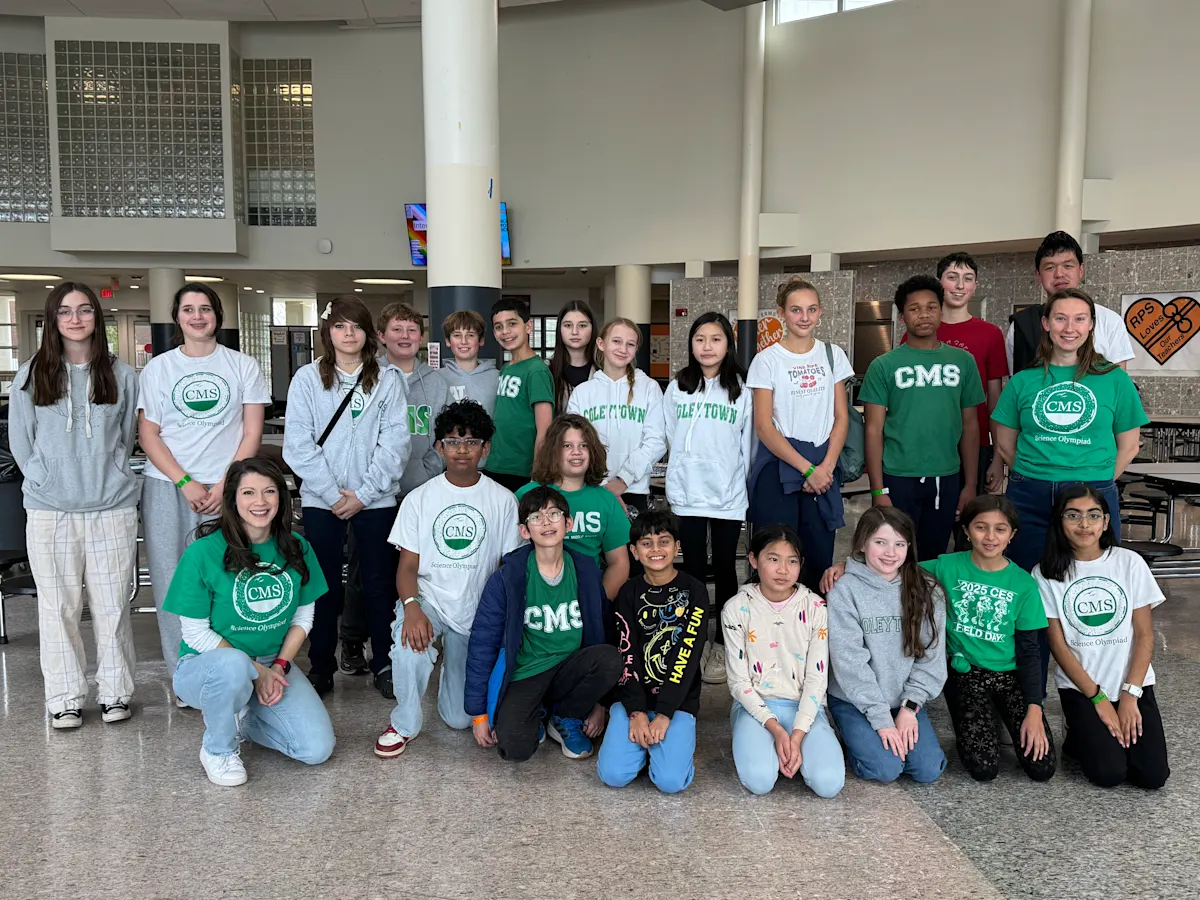










On December 6, 2025, Coleytown Elementary School’s Science Olympiad club competed at an invitational at Ridgefield High School.
What is Science Olympiad?
Science Olympiad is a competitive international team-based educational event that focuses on STEM and other science topics, such as robotics, biology, and physics. Students practice collaboration by working together with a partner to research a topic or create a project.
Students choose up to four topics called events and work with a partner. There are four types of events:
Core Knowledge
Core knowledge events are research-based. Students will research and study a list of subtopics that are different every season. At the invitational event, students who are participating in the Core Knowledge event will take a fifty to sixty minute test about the topics that they studied. (e.g. Anatomy and Physiology, Meteorology, Disease Detectives.)
Build
Build events are based on designing and constructing a project. Students are given parameters that they must follow when constructing. At a competition, participants may answer questions about the design, construction, or operation of the project. The participants will present or run their vehicle or project. The team with the highest score wins. (e.g. Boomilever, Hovercraft.)
Hands on / Laboratory
Hands on/Laboratory events are research-based but also require participants to conduct experiments and/or write a report. Students will research topics as preparation for the event. At a competition, students will conduct a hands-on experiment, record data, and possibly write a report. (e.g. Potions and Poisons, Crime Busters.)
Hybrid
Hybrid events have two or more elements from the other types of events. (e.g. Water Quality, which is a combination of core knowledge and lab event).
Divisions
There are three divisions in Science Olympiad: Division A, Division B, and Division C. These divisions are used to separate age groups. Division A is for kindergarten to sixth grade. Division B is for students in grades six to nine, and each team may consist of at most 15 members with a maximum of five ninth graders within that limit. Division C is for grades nine to twelve, and each team may consist of at most 15 members with a maximum of seven twelfth graders. All teams in any division may attend local, state, or national invitationals.
2025-2026 Events
This school year, there will be multiple events and competitions that the CMS Science Olympiad team will be participating in, including:
- Ridgefield Invitational: Dec. 6, 2025 at Ridgefield High School.
- Satellite invitationals are invitationals that take place online, consisting of online tests and Zoom meetings for communication. There will be three this year, and the dates are Jan. 17 (builders only!), Jan. 24 and Jan. 31 (High Desert Invitational).
- UCONN Invitational: Feb. 14, 2026 at UCONN.
- Connecticut State Tournament: March 14, 2026 at Coventry Middle School. The state tournament is for all the teams in the state to compete, and a certain number of admitted teams, typically the top three, will attend the Science Olympiad National Tournament. Nationals is the competition where 60 admitted teams will compete.
So far, the CMS Science Olympiad team participated in two events this school year: Ridgefield Invitational, and builders have gone to a satellite event on 1/17. They are looking forward to upcoming events!
Ridgefield Invitational
On December 6, 2025, the CMS Science Olympiad team participated in Ridgefield Invitational at Ridgefield High School. The other participants included Collegiate School, and Scotts Ridge Middle School (SRMS). This was the first invitational for the 2025-2026 season.
Results:
Collegiate School won top 3 in most of the events and placed first overall.
Coleytown Middle School placed top 3 in many events as well, and placed in second overall.
SRMS occasionally reached the podium for specific events, and placed third overall.
Why participate?
Science Olympiad can be a learning opportunity for many students. Students practice time management and studying effectively.
“Science Olympiad has helped me do better in school by improving my science and studying skills. It helped me learn how to understand topics instead of just memorizing them. I also got better at solving problems and managing my time between schoolwork and Science Olympiad.” Science Olympiad member Adele Khisyamov said.
In addition, since participants will likely work with a partner, they can practice collaborating.
“Participating in Science Olympiad improves collaboration and communication. Working with a partner teaches you how to share ideas and listen to each other. You learn how to work together, divide tasks, and help each other during practices and competitions.” Khisyamov said.
Ultimately, Science Olympiad is a club for students to collaborate with a partner to research a topic to expand their knowledge, or to design and build a project to present their proficiency in their event.
Sources:
https://www.soinc.org/start-team/team-size-grade-levels
https://cms.westportps.org/cms-news/news-details/~board/coleytown-news/post/cms-science-olympiad